Repair experiments cited for KLOW peptide
The tendon has to bear a load. The skin has to make supporting material. These experiments become more interesting when “repair” acquires a particular job.
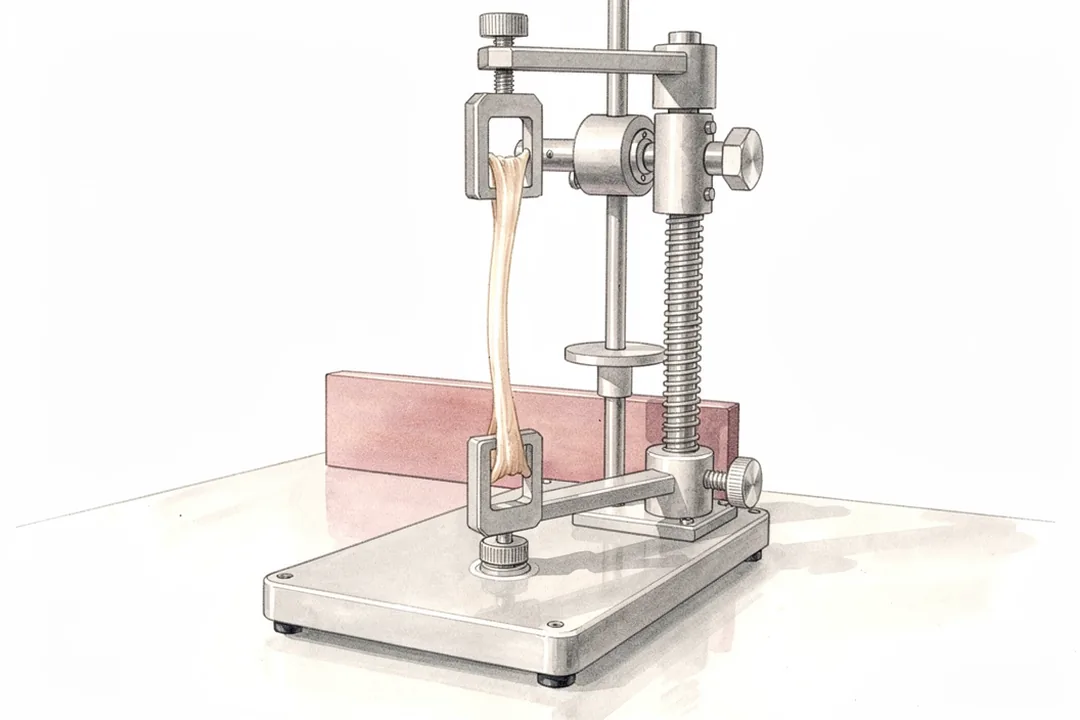
A tendon tested under load
In the rat Achilles-tendon experiment, the tendon was completely transected: cut through. BPC-157 improved biomechanical and functional recovery, alongside the microscopic findings. I was particularly persuaded by the inclusion of mechanical testing alongside the appearance of healing.
I put mechanical strength ahead of an attractive picture of newly formed tissue. The experiment still concerns injured rats given BPC-157. It supplies neither a recovery forecast for a person nor a test of KLOW's four ingredients together.
A separate rat knee-ligament study also reported better biomechanics, function and microscopic healing. In rat tendon-cell cultures, BPC-157 increased cell outgrowth, survival and migration. These findings describe related aspects of repair at different scales; none tracked the long-term safety of a human blend treatment.
KPV colitis experiments
Dalmasso and colleagues tested KPV uptake in human intestinal and immune cells grown in the laboratory, and in mice with chemically induced colitis. PepT1, a transport protein that brings short peptides into cells, helped KPV reach the cells. Inflammatory signaling and cytokine release fell; oral KPV reduced colitis severity in the mice. Cytokines are the messages cells use to recruit and direct an immune response.
The delivery experiments became quite elaborate. In a mouse study using targeted nanoparticles, the carrier helped KPV reach inflamed colon tissue and improved the outcome relative to non-targeted delivery. In a 2024 mouse colitis experiment, a targeted formulation combining KPV with the immunosuppressant FK506 improved acute and chronic colitis beyond either agent alone and restored more tight-junction proteins, which help seal the bowel lining.
I admire the bowel work's specificity. Its success depends on a particular formulation, destination and disease model. KLOW has its own combination experiment still to undergo.
The skin result that gets compressed into a percentage
The 2015 GHK review reports increased collagen production in 70% of women treated topically with GHK-Cu, compared with 50% for vitamin C and 40% for retinoic acid. These percentages count women showing an increase. They give no percentage increase in an individual woman's collagen.
Collagen supplies tissue with structural support. GHK-Cu also has a broad cell-level literature involving other supporting molecules, antioxidant defenses and gene expression. The 2018 gene-data review describes increased expression of 59% of affected genes and reduced expression of 41%. Those percentages concern gene activity, a different outcome again.
I favor the topical skin results here because the route and tissue match the question. The unanswered systemic safety questions become much larger when that literature is used to support an injected blend. In a separate experiment on human skin outside the body, researchers measured copper penetration and retention; they were measuring a skin barrier, with no whole person receiving KLOW.
Skin covering; follicle growth
Malinda and colleagues treated full-thickness rat wounds with thymosin beta-4. Re-epithelialization—the spread of fresh surface skin—was 42% greater after four days and up to 61% greater after seven days. The wounds also gained collagen and blood vessels. The tested substance was the full-length protein, whereas TB-500 in KLOW is its short fragment.
Hair research brings another identity problem. Human hair follicles outside the body elongated with AHK-Cu, an analog distinct from GHK-Cu. Thymosin beta-4 encouraged hair growth in rodents through follicle stem-cell migration and differentiation. Neither experiment demonstrates hair growth from KLOW.
I resist collapsing those names into one encouraging story. The differences are part of the chemistry that produced the findings, and preserving them makes the experiments more useful.
Blood supply carries a safety question
In BPC-157 vascular experiments, researchers linked vessel growth to VEGFR2 activation and downstream signaling. The work included human vascular cells in culture, a chick membrane model and rat muscle with impaired blood supply. Vessel density increased, and blood-flow recovery improved in the rat model.
That helps explain the repair interest. It also gives the follow-up a concrete task: investigate the consequences where new vessels could be unwelcome, including a current or recent cancer. The concern is theoretical; these experiments did not establish that KLOW causes or worsens cancer.
The 2026 review of musculoskeletal peptide therapies finds promising animal outcomes alongside scarce rigorous human safety data. To me, that combination justifies a serious next experiment, with benefits and harms both recorded.